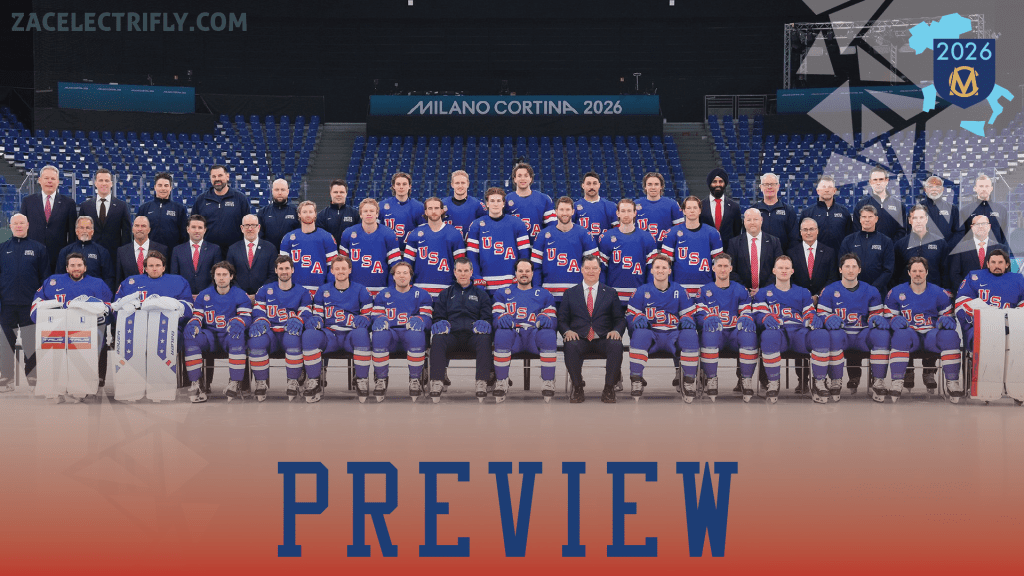

The United States men’s ice hockey team enters the Olympics carrying the weight of history and expectation. Team USA has not won an Olympic gold medal since the Miracle on Ice in 1980, a 46-year drought that continues to loom large over the program. The Americans are also searching for their first Olympic medal since 2010, after finishing fifth at Beijing 2022. These Games mark a major turning point, as NHL players are returning to the Olympic stage for the first time in years, giving the United States a level of elite talent they believe can finally push them back to the top. Slotted into Group B alongside Germany, Latvia, and Denmark, the United States will open tournament play against Latvia, followed by Denmark, before closing out the group stage with a highly anticipated matchup against Germany. There is a growing sense of optimism surrounding this U.S. squad, fueled by strong performances in recent international competitions. The intensity ramped up significantly during the 2025 NHL 4 Nations Face-Off, where emotions spilled over as Canadian fans booed the U.S. national anthem, leading to multiple fights at the opening faceoff. That edge and hostility have followed the Americans into the Olympic tournament. Pressure on Team USA comes from every angle: expectations of gold, political undertones, and the reality of being viewed as the villain by much of the international field. Still, this may be the most complete and talented roster USA Hockey has assembled in decades. The storyline is clear and two-fold: redemption through a long-awaited gold medal, and the challenge of embracing the role of the team everyone else wants to beat.
The United States roster is entirely composed of players on NHL contracts, underscoring the elite nature of this group. Auston Matthews of the Toronto Maple Leafs serves as captain, with Matthew Tkachuk of the Florida Panthers and Charlie McAvoy of the Boston Bruins wearing alternate captain “A”s. In goal, the Americans boast one of the strongest trios in the tournament with Jeremy Swayman, Jake Oettinger, and Connor Hellebuyck. Swayman, a fourth-round pick in 2017, has already surpassed 200 NHL games. Oettinger, a first-round selection in the same draft year, has matched that experience level, while Hellebuyck brings veteran leadership with over 600 NHL games since being drafted in 2012.
Up front, the depth and star power are undeniable. Brady Tkachuk, Jack Eichel, J.T. Miller, Matthew Boldy, Vincent Trocheck, Matthew Tkachuk, Dylan Larkin, Brock Nelson, Auston Matthews, Jake Guentzel, Tage Thompson, Kyle Connor, Jack Hughes, and Clayton Keller form a forward group that blends youth, experience, scoring touch, and playoff pedigree. Several of these players have surpassed 700 or even 1,000 NHL games, while others represent the next generation of American stars. Stanley Cup experience is also well represented, with Eichel, Guentzel, and Tkachuk among those who have lifted the Cup, bringing championship confidence into the locker room.
The blue line is just as impressive, anchored by a mix of established veterans and emerging talents. Zach Werenski, Noah Hanifin, Charlie McAvoy, Quinn Hughes, and Jaccob Slavin provide stability and elite puck-moving ability, while younger defensemen like Brock Faber, Jake Sanderson, and Jackson LaCombe add speed and modern defensive instincts. Faber is one of the few players on this roster who also suited up for the United States at Beijing 2022, offering valuable Olympic experience to a group otherwise new to this stage.
From a group-stage perspective, the path looks favorable on paper. The United States has only faced Latvia once before in Olympic play, a game that ended in a draw, but Team USA enters heavily favored. The matchup with Denmark will be the first-ever Olympic meeting between the two nations in men’s ice hockey, and again the Americans are expected to control the game. Germany presents the toughest group-stage test, though history strongly favors the United States. In ten Olympic meetings, the Americans have won nine times and hold a commanding 53-11 goal differential. Their most recent Olympic clash came at Beijing 2022, a narrow 3-2 U.S. victory, followed by a 6-3 American win at the 2025 IIHF World Championship.
The larger picture, however, extends beyond the group stage. The United States is aiming for a top-four overall ranking, which would secure an automatic berth into the quarterfinals. A win there would guarantee a spot in the medal round. If both the United States and Canada finish among the top two overall seeds, the sport’s fiercest rivals would avoid each other until the medal games. For Team USA, the mission is clear: navigate the early rounds, embrace the pressure, and seize what may be their best opportunity in nearly half a century to bring Olympic gold back to American hockey.




 Zac Electrifly
Leave a comment