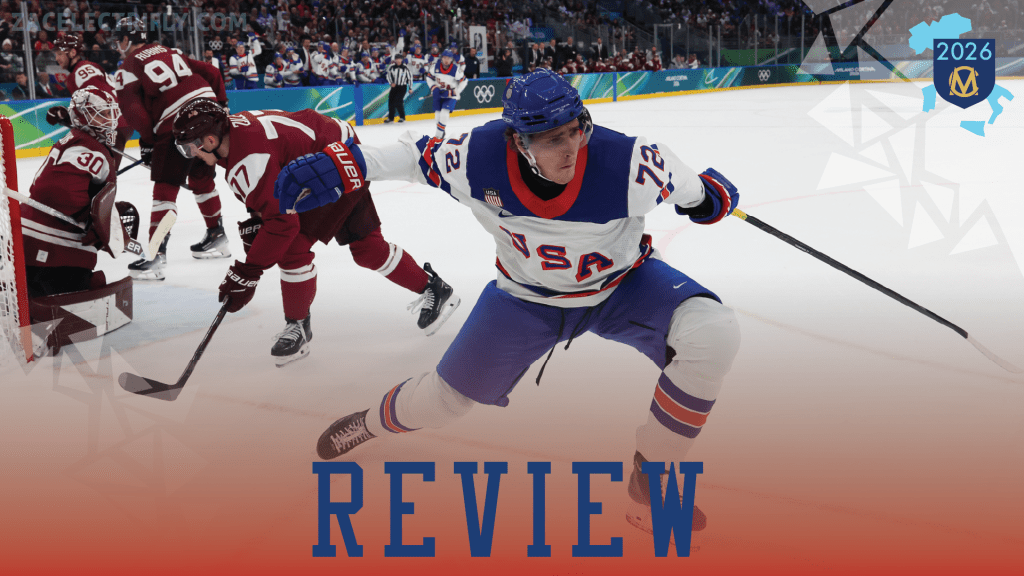

The United States men’s national ice hockey team opened their campaign at the 2026 Winter Olympics on Thursday with a highly anticipated Group A matchup against Latvia men’s national ice hockey team. With the puck dropping in Milano Cortina, both teams entered the contest in the exact same position: 0-0-0, tied with everyone else in the group, and still carrying the mystery that comes with an Olympic opener. No games played. No goals scored. No standings separation. Just expectation.
For the United States, those expectations were enormous. This wasn’t just another group-stage game. This was the first Olympic appearance featuring NHL players in quite some time, and that alone brought pressure. Questions surrounded this American roster. Would the talent translate quickly? Would chemistry develop fast enough? Could they live up to the gold-medal aspirations that follow them into every best-on-best tournament? Latvia, meanwhile, entered as the underdog, but a dangerous one. They were looking to punch above their weight and steal early momentum against a perceived powerhouse. The two nations had met only once before in Olympic history, a 3-3 tie back in 2006. The Americans were determined not to let history repeat itself. Latvia, on the other hand, embraced the spoiler role. An early upset would shake up the entire group.
The United States also arrived in this tournament wearing the unofficial “villain” label. Their rivalry with Canada continues to simmer, especially after tensions boiled over at the 2025 NHL 4 Nations Face-Off, when Canadian fans booed the American national anthem and fights erupted to open the game. Political undertones only added fuel to the fire. That edge (that us-against-the-world mentality) has followed Team USA into Milano Cortina. They’re viewed as a powerhouse, but in some ways still treated like underdogs. Hated by rivals. Targeted by everyone. And fueled by it.
It took just five minutes for the Americans to make their presence known. Brady Tkachuk scored the first U.S. goal of the tournament, finishing a play set up by Matthew Tkachuk and Zach Werenski. It was a statement start, physical, aggressive, confident.
The United States appeared to double their lead soon after, but Latvia successfully challenged the play, wiping the goal off the board. That reversal shifted the energy in the building. Riding that momentum, Latvia struck back seven minutes into the period. Renars Krastenbergs beat the American defense off a feed from Zemgus Girgensons to tie the game 1-1. Suddenly, the Americans were on notice.
The United States thought they had reclaimed the lead again, but Latvia won another challenge, erasing a second U.S. goal. It was a frustrating stretch. Two goals called back. Momentum swings. Missed clears. With under five minutes remaining in the first period, Krastenbergs was called for holding, but the Americans couldn’t convert before intermission. After twenty minutes, the score was tied 1-1, and the tension was real.
Just forty seconds into the second period, Jake Guentzel was whistled for hooking, giving Latvia an early opportunity. The Americans killed it off and began to settle into their game. Midway through the period, Brock Nelson broke the deadlock, finishing a setup from Jack Hughes and Vincent Trocheck. That goal felt different, cleaner, calmer, more controlled.
Late in the period, Roberts Mamcics was penalized for cross-checking, and this time the U.S. power play delivered. Tage Thompson blasted one home off assists from Jack Eichel and Quinn Hughes, stretching the lead to two.
Then, with under thirty seconds remaining in the second period, Nelson struck again. His second goal of the night, assisted by Jack Hughes and Matthew Tkachuk, sent the Americans into the locker room with a commanding 4-1 lead. The game had flipped completely.
Latvia made a goaltending change to start the third period, replacing Elvis Merzlikins with Arturs Silovs in hopes of sparking something. But just one minute into the frame, Auston Matthews buried another U.S. goal, assisted by Jack Eichel and Quinn Hughes, extending the lead to 5-1 and effectively sealing the outcome.
There were still moments of physicality. Midway through the third, Dylan Larkin was called for slashing. Later, Brock Faber was assessed two slashing penalties (one served by Brady Tkachuk) while Eduards Tralmaks took a cross-checking minor for Latvia during the same sequence. Both teams finished with eight penalty minutes, but the damage had long been done. The final score: 5-1, United States.
Statistically, the Americans dominated. They outshot Latvia 38-18. Connor Hellebuyck had a relatively comfortable night, stopping 17 of 18 shots for a 94% save percentage. Merzlikins turned aside 28 of 32 shots for a 87% save percentage, while Silovs stopped 5 of 6 for a 83% save percentage. Special teams played a key role; the United States went 2-for-3 on the power play, while Latvia went 0-for-3.
But beyond the numbers, this game told a bigger story. It was frustrating early. Two goals erased. Shots clanging off the post. A costly failed clear that led to Latvia’s tying goal. For a moment, it felt like one of those Olympic openers where tension tightens sticks and doubt creeps in. Then the Americans found their footing. From the middle of the second period on, Latvia simply couldn’t keep up with what the United States was generating. Every goal felt like a team goal. No one forced plays. No one hunted personal stats. The puck moved crisply. The decision-making was patient. It was selfless hockey, layered offense, structured defense, and relentless pressure. Even with a four-goal lead, the U.S. played like the game was tied. The intensity never dipped. The questions about whether this NHL-powered American roster would click? Consider them answered, at least for now.
With the win, the United States improved to 1-0-0 and earned three points. They currently lead Group C and sit third overall in the standings, three points behind Canada and Slovakia. The U.S., Latvia, and Germany all have three points in the group, though Latvia and Germany have already played twice, while the Americans have played just once. As it stands, the United States occupy a quarterfinal position.
Next up: Denmark. The Americans will face Denmark on Saturday, February 14th, 2026, at 12:10 PM in their second group-stage game at the 2026 Winter Olympics. There’s even some tongue-in-cheek political humor floating around online, jokes that the winner “gets Greenland.” Beneath the memes, however, Denmark is hunting for the upset of the tournament, while the United States is looking for a Valentine’s Day win to continue building momentum. If this opener proved anything, it’s this: Team USA isn’t in Milano Cortina just to compete. They’re here to win.



 Zac Electrifly
Leave a comment