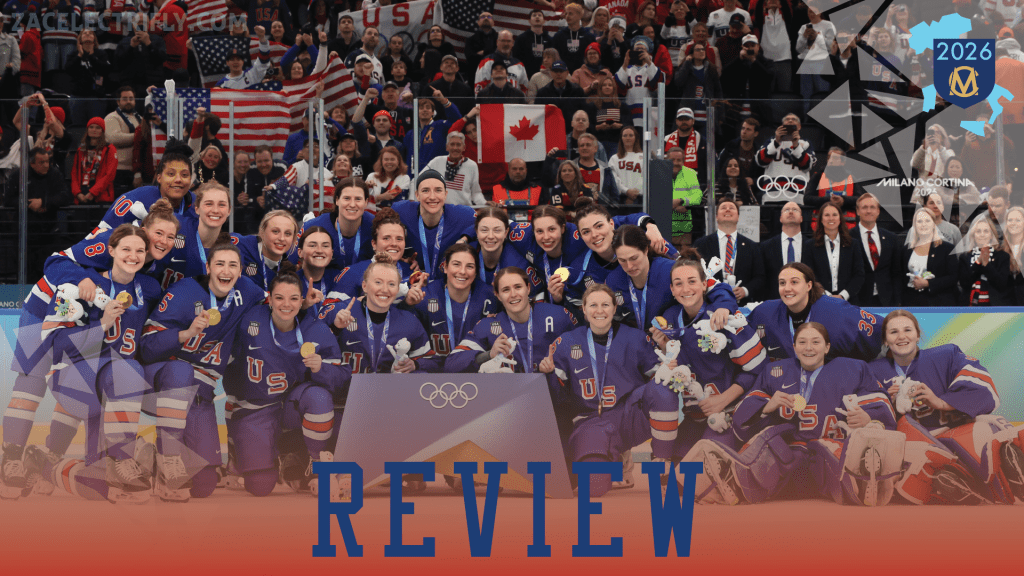

On Thursday, the United States and Canada met once again on the sport’s biggest stage, facing off in the women’s ice hockey gold medal game at the Milano Cortina 2026. It was the latest chapter in the greatest rivalry in women’s sports, and everything about this matchup felt massive. The United States entered the game as the top team in Group A, finishing the group stage undefeated and first in the overall standings. They carried that dominance into the knockout rounds, defeating Italy in the quarterfinals and Sweden in the semifinals. Even more impressive, the Americans came into the gold medal game riding a streak of five straight shutouts, setting the tone as the most defensively dominant team in the tournament. Canada, meanwhile, finished second in Group A with a 3-1-0 record and placed second in the overall standings. They powered past Germany in the quarterfinals and Switzerland in the semifinals to earn their shot at gold. The two rivals had already met in the group stage, where the United States delivered a statement 5-0 victory. The Americans were on a dominating streak and playing on a completely different level, looking like a team on a mission from the first puck drop of the tournament. Canada entered the final determined to prove they should never be counted out, bringing both pride and urgency into a game that also carried underlying political tension, adding another layer of intensity to an already passionate rivalry.
The game itself started tight and physical. Just five minutes in, the United States was called for too many players on the ice, giving Canada an early power-play opportunity. With under five minutes remaining in the first period, Joy Dunne of the USA was whistled for tripping. Then, with less than a minute left in the opening frame, Ella Shelton of Canada was called for hooking. Despite the penalties and high pace, neither side could break through, and the first period ended scoreless at 0-0. It was clear this would not be another lopsided result.
Early in the second period, Canada struck first. Just 54 seconds in, while short-handed, Kristin O’Neill scored to open the scoring. The goal, assisted by Laura Stacey and Renata Fast, shifted momentum and stunned a U.S. team that had not trailed all tournament. Canada carried that 1-0 lead through the rest of the second period, tightening up defensively and forcing the Americans to chase the game for the first time in a while.
As the third period ticked down, the tension inside the arena built shift by shift. With under seven minutes remaining, Britta Curl of the United States was called for boarding, putting even more pressure on the Americans. Time continued to slip away, and with under three minutes left, the U.S. coaching staff made the bold but necessary move to pull the goalie for the extra attacker. Just twenty seconds later, Hilary Knight delivered in a moment that will live in Olympic history, scoring the tying goal and breathing life back into Team USA. The arena erupted, and suddenly the momentum had completely flipped.
The third period ended tied 1-1, sending the gold medal game to overtime.
Four minutes into the extra frame, Megan Keller produced one of the most electrifying goals ever. Assisted by Taylor Heise, Keller weaved around a defender and powered through the goalie as if neither were there, finishing the play with confidence and skill to secure the victory. It was a goal worthy of gold.
With that overtime winner, the United States captured gold in women’s ice hockey at Milano Cortina 2026, while Canada earned silver. Even though the Americans trailed for much of this game, they were never out of it. They kept pushing, kept believing, and were rewarded with two clutch goals when it mattered most. Their resilience matched their dominance throughout the tournament.
Statistically, the game was as tight as expected. The United States outshot Canada 33-31. The USA went 0-for-1 on the power play, while Canada went 0-for-3. Aerin Frankel was outstanding, stopping 30 of 31 shots for a 96% save percentage. Ann-Renée Desbiens turned aside 31 of 33 shots for Canada, finishing with a 93% save percentage. Both goaltenders were phenomenal, continuing the trend of elite netminding that defined the tournament. This gold medal marks the third in history for the United States, adding to their championships in 1998 and 2018. The USA has now medaled in women’s ice hockey every single time the event has been held at the Winter Olympics, earning medals in 1998, 2002, 2006, 2010, 2014, 2018, 2022, and now 2026. Canada has also medaled every year women’s ice hockey has been part of the Winter Olympics and now holds eight total Olympic medals in the sport.
With this game, the women’s ice hockey tournament at Milano Cortina 2026 has officially come to an end. The men’s tournament will wrap up on Sunday, and the Olympic flame will soon be extinguished. The next chapter of the Winter Games will take place at the 2030 Winter Olympics in the French Alps. But for now, the spotlight belongs to Team USA — gold medalists once again, champions of Milano Cortina 2026.




 Zac Electrifly
Leave a comment