

The Tahoe Knight Monsters returned to the ice for game fifty-four of the season as they once again squared off against the Utah Grizzlies in what has become an increasingly heated and meaningful late-season divisional matchup. With the playoff race tightening in the ECHL, every point carries significant weight, and this contest was no exception. Tahoe entered the game sitting fourth in the division with a 27-21-5 record and momentum on their side after a recent victory over Utah. As the ECHL affiliate of the Vegas Golden Knights, the Knight Monsters continue to balance the dual priorities of player development and winning hockey. Their recent stretch has been a mixed bag, highlighted by timely scoring but also marked by occasional defensive lapses. As the regular season begins to wind down, Tahoe understands that consistency will be the difference between simply qualifying for the playoffs and potentially earning home-ice advantage or climbing even higher in the standings. Across the ice, the Grizzlies entered the matchup seventh in the division with a 20-26-7 record. As the ECHL affiliate of the Colorado Avalanche, Utah came into the game looking to knock off a playoff-positioned opponent and gain momentum of their own. Despite their place in the standings, the Grizzlies have shown throughout the season that they are capable of competing with top teams, particularly in divisional matchups where familiarity often fuels intensity. For a team trying to stay relevant in the playoff conversation, every game presents a chance to build confidence, shift momentum, and potentially play spoiler against teams ahead of them. This particular matchup also carried a deeper historical significance. It was likely the final meeting between the Knight Monsters and the Grizzlies, as Utah is expected to relocate following the season. That reality added an emotional layer to the night. Rivalries in the ECHL are often built through repeated divisional battles over the course of a season, and Tahoe and Utah have certainly developed a competitive edge against one another. If this game truly represented the final chapter between the two clubs, both teams were determined to close the rivalry with a strong performance. With playoff implications, organizational pride, and the potential farewell meeting all wrapped into one night, this was more than just game fifty-four; it was a meaningful moment in the histories of both franchises.

Between the pipes, Jordan Papirny got the start for Tahoe, marking his 25th appearance of the season for the Knight Monsters. Papirny has been a steady and reliable presence in net, and as the games become increasingly important, his consistency continues to be a key factor in Tahoe’s postseason push. Opposing him was Hunter Miska, who was making just his fourth appearance of the season for Utah. With limited action on the year, Miska had an opportunity to make a statement against a team currently sitting in a playoff position.

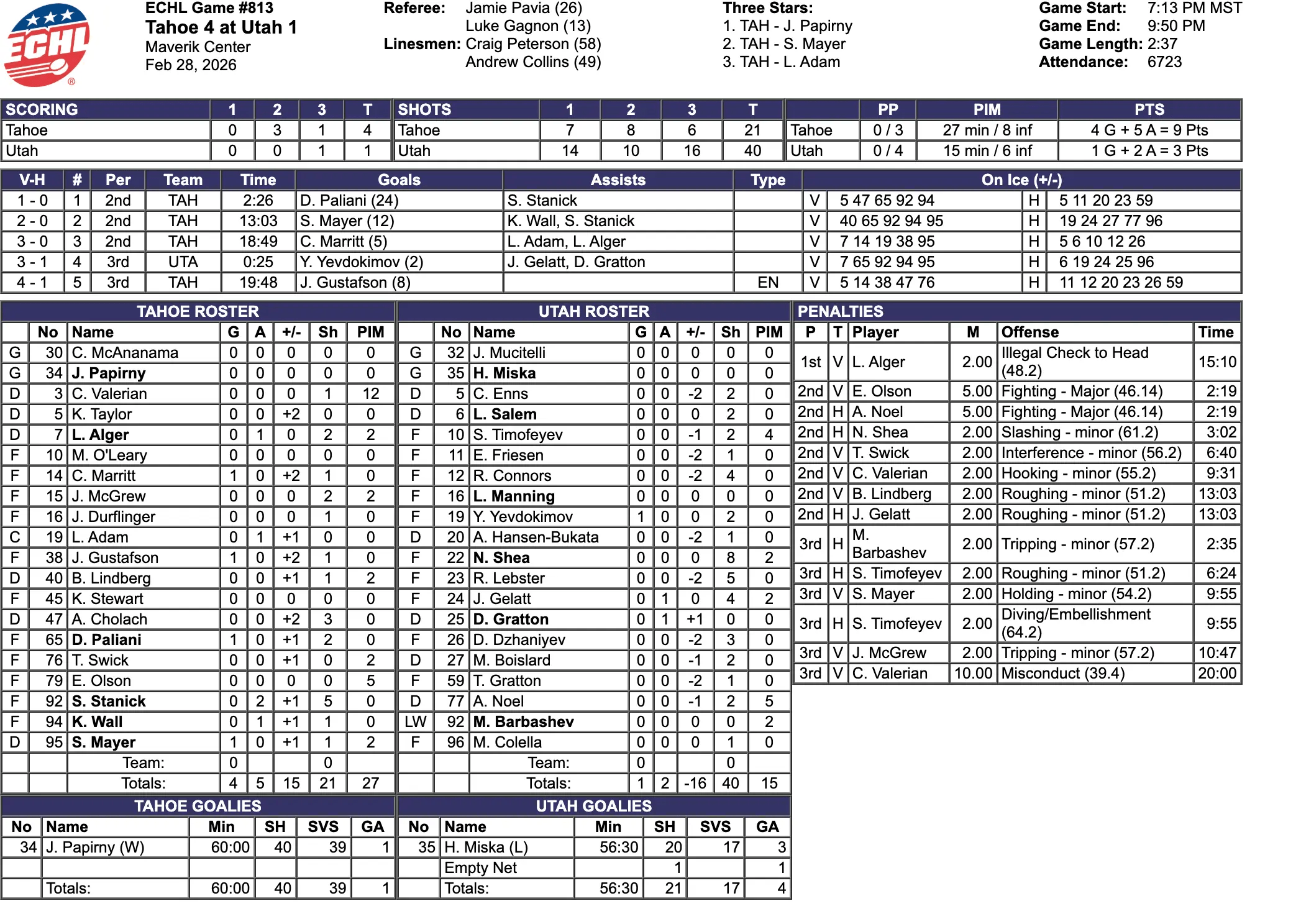
The opening period featured physical play and tight defensive structure from both teams, with neither side able to break through offensively. With under five minutes remaining in the first period, Linden Alger of Tahoe was called for an illegal check to the head, giving Utah an early power-play opportunity. However, the Knight Monsters’ penalty kill held strong and prevented the Grizzlies from capitalizing. Both goaltenders were sharp throughout the period, and despite several scoring chances at each end of the ice, the game remained scoreless heading into the first intermission with the teams tied 0-0.

The intensity ramped up early in the second period. Just two minutes in, Eric Olson of Tahoe and Andrew Noel of Utah dropped the gloves and were both assessed fighting majors, setting the tone for a physical middle frame. Shortly after the fight, Tahoe found the breakthrough they were looking for. Devon Paliani opened the scoring for the Knight Monsters, giving Tahoe a 1-0 lead. The goal was assisted by Sloan Stanick.
The parade to the penalty box continued as the period progressed. Three minutes into the second, Neil Shea of Utah was called for slashing. Six minutes into the period, Trent Swick of Tahoe was penalized for interference, followed by a hooking call against C.J. Valerian at the nine-minute mark. Despite the steady stream of penalties, the Knight Monsters managed to extend their lead late in the period. With under seven minutes remaining in the second, Samuel Mayer scored to make it 2-0 for Tahoe. The goal was assisted by Kevin Wall and Stanick, giving Stanick his second assist of the night.
During the same sequence of play, tensions flared again as Benjamin Lindberg of Tahoe and John Gelatt of Utah were both assessed roughing penalties. Tahoe continued to press offensively, and their pressure paid off once more late in the period. With under two minutes remaining in the second, Connor Marritt extended the Knight Monsters’ lead to three goals. The tally was assisted by Luke Adam and Alger.
After forty minutes of play, Tahoe held a commanding 3-0 advantage.

Utah responded quickly in the third period in an effort to spark a comeback. Just twenty-five seconds into the final frame, Yaroslav Yevdokimov put the Grizzlies on the board, cutting the deficit to 3-1. The goal was assisted by Gelatt and Dylan Gratton. The early goal gave Utah life, but Tahoe’s defensive structure and strong goaltending from Papirny prevented the Grizzlies from building further momentum.
Penalties continued to shape the flow of the period. Two minutes into the third, Maxim Barbashev of Utah was called for tripping. Four minutes later, Stepan Timofeyev of Utah was penalized for roughing. At the nine-minute mark, Mayer of Tahoe was called for holding while Timofeyev was assessed an embellishment penalty on the same play. Later in the period, with under nine minutes remaining, Jake McGrew of Tahoe was called for tripping, giving Utah another opportunity to close the gap. However, the Grizzlies were unable to solve Papirny again. With Utah pushing late and their goaltender pulled for the extra attacker, Jordan Gustafson sealed the game with an empty-net goal with under a minute remaining, extending the lead to 4-1.
After the whistle at the end of the game, Valerian of Tahoe was assessed a ten-minute misconduct. When the final horn sounded, the Knight Monsters had secured a convincing 4–1 victory.

https://echl.com/videos/tahoe-knight-monsters-vs-utah-grizzlies-feb-28-2026

The Tahoe Knight Monsters may not have dominated the shot clock, but they controlled the moments that mattered most in their win over the Utah Grizzlies. This was a classic example of efficiency beating volume. A big key to the win was Tahoe’s ability to strike at key moments in the second period. After a scoreless opening frame, the Knight Monsters erupted for three goals in the middle period from Devon Paliani, Samuel Mayer, and Connor Marritt. That surge flipped the momentum entirely and forced Utah to chase the game for the rest of the night. It also highlighted the depth scoring Tahoe has been relying on throughout the season. Special teams didn’t produce goals for either side, but Tahoe’s penalty kill deserves credit. The performance also reinforced how important Papirny has become for Tahoe’s playoff push. When a team allows a lot of shots, the goaltender becomes the difference-maker, and Papirny delivered one of his strongest outings of the season. If he continues playing at that level, the Knight Monsters will remain a difficult team to beat as the postseason approaches. Finally, the emotional layer surrounding the game added a unique element. With the Grizzlies expected to relocate after the season, this may have been the final chapter in the on-ice history between these two clubs. If that proves to be the case, Tahoe closed the rivalry with a strong and decisive performance. With the win, the Knight Monsters continue to solidify their playoff position in the ECHL. Consistency will still be the key moving forward, but performances like this, where goaltending, opportunistic scoring, and strong defensive moments come together, are exactly the kind of games that playoff teams learn how to win.

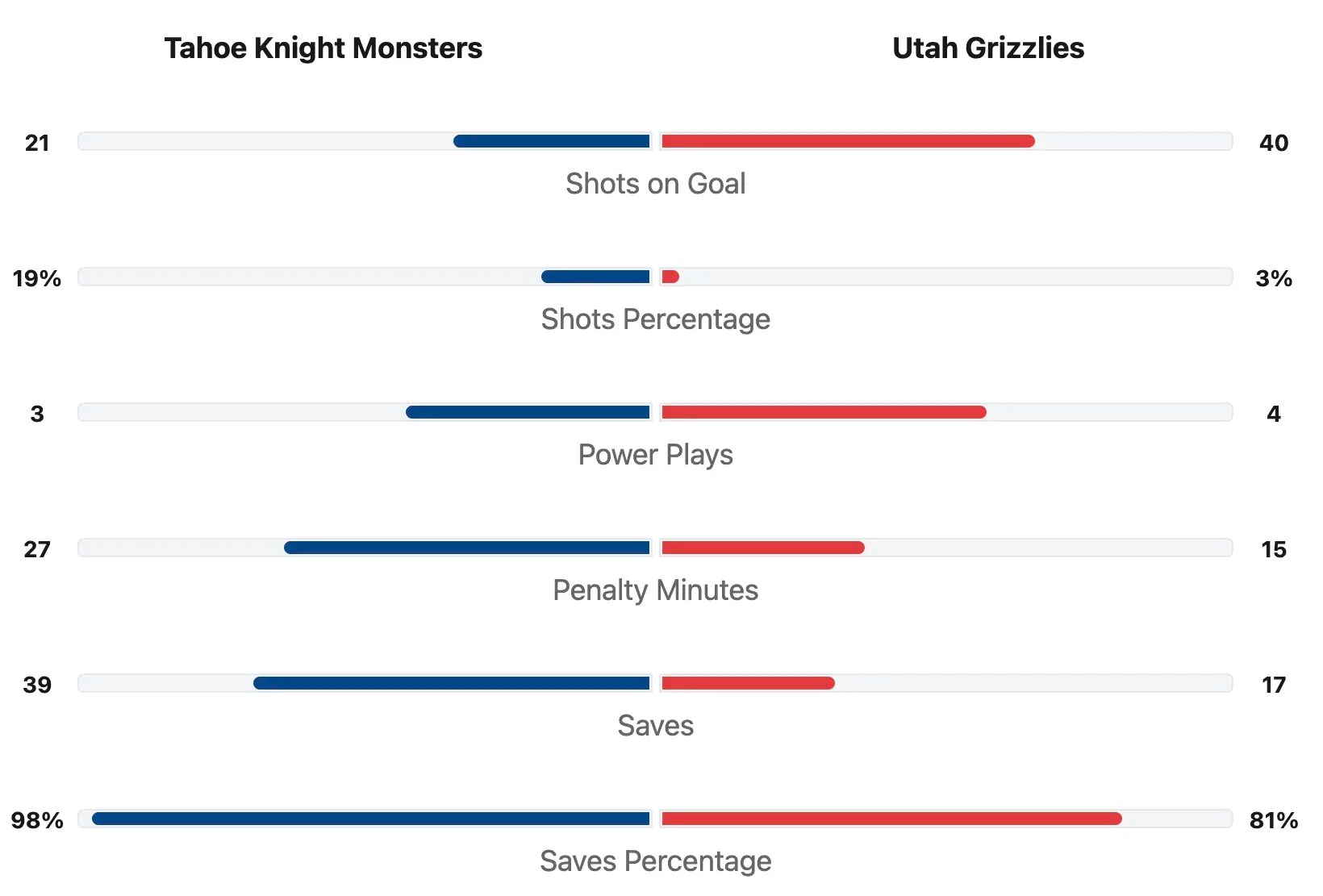
Despite the loss, Utah generated significantly more offensive pressure. The Grizzlies recorded 40 shots on goal compared to just 21 for the Knight Monsters. However, Tahoe made the most of their opportunities, finishing with a far superior shooting percentage. The Knight Monsters converted at a 19% rate, while Utah managed just 3%. Special teams were also a factor, though neither side capitalized. Tahoe finished 0-for-3 on the power play, while Utah went 0-for-4. The game was also a physical one, reflected in the penalty totals. Tahoe accumulated 27 penalty minutes, compared to 15 for Utah. Papirny delivered a standout performance in net for the Knight Monsters, stopping 39 of 40 shots for an impressive 98% save percentage. On the other side, Miska stopped 17 of 21 shots for an 81% save percentage.

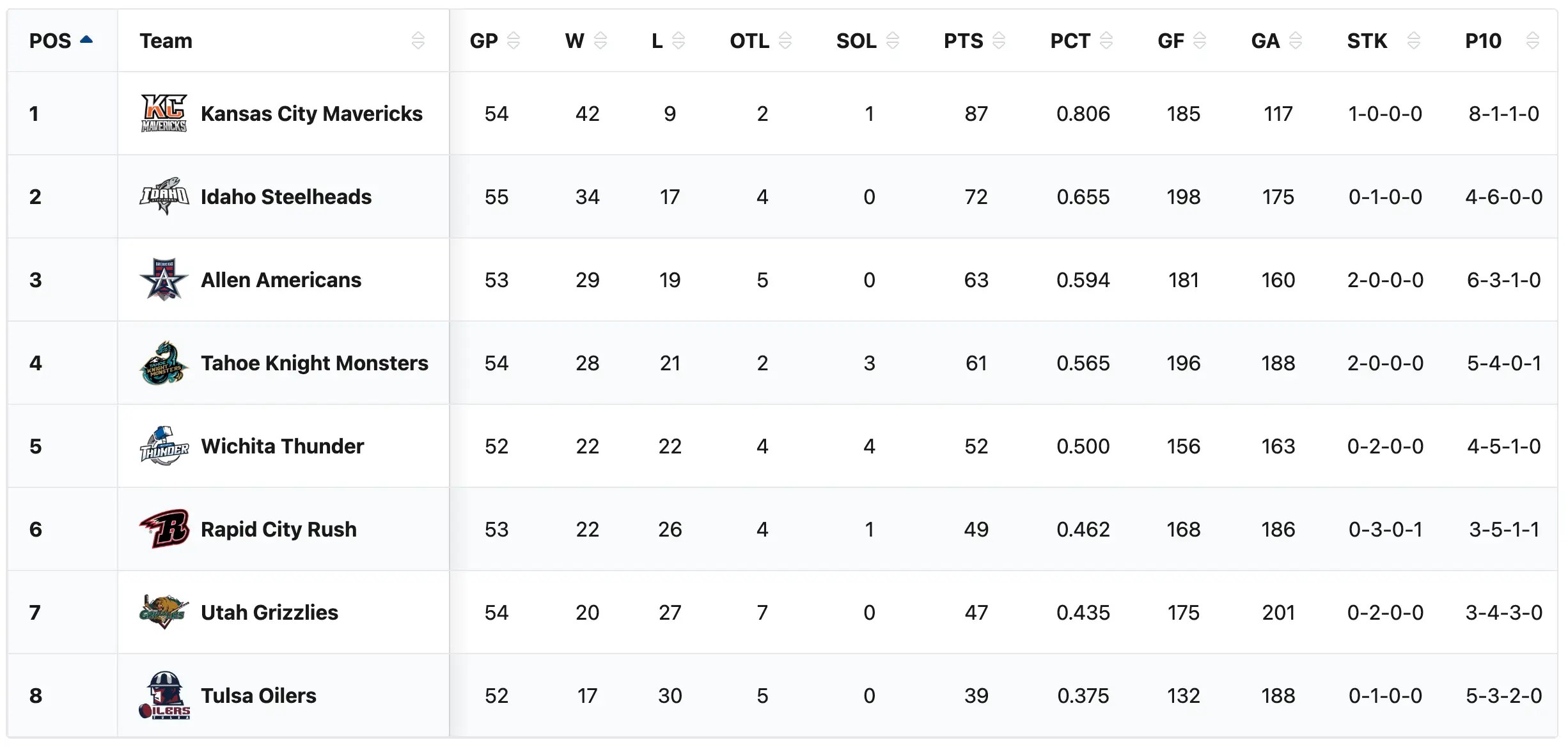
With the victory, the Knight Monsters improved to 28-21-5 on the season, good for 61 points through 54 games. They remain fourth in the Mountain Division of the ECHL’s Western Conference while sitting 13th overall in the league and sixth in the conference standings. Although Tahoe remains 26 points back of the top spot in the league, conference, and division, the more immediate focus is on movement within the division. The Knight Monsters are now just two points—or one win—away from reclaiming third place while maintaining a comfortable nine-point cushion over fifth place. Most importantly, Tahoe remains firmly in a playoff position and currently shows no signs of falling out of the postseason race.

The Knight Monsters will now shift their focus to their next challenge as they travel to face the Kansas City Mavericks in game fifty-five of the season. The matchup will take place in Independence, Missouri at Cable Dahmer Arena, with puck drop scheduled for 5:00 PM.

 Zac Electrifly
Leave a comment